

Team as a product
You open a game's page — cover art, description, screenshots, price and a "buy" button. Everything is in place. But behind the scenes remain the programmer who chased an elusive bug, the artist who redrew the title screen, the musician who searched for the mood, the writer and the narrative designer. They made the game. And on the page, all that's left of them is a line with the team name — and sometimes even that's missing.
A game is the result. A team is the process. The process is usually invisible.
The old scheme
Previously, for every new game I sent out a newsletter to all users of the site. The audience was around 4,500 people, and that gave the game a very strong start.
But the scheme worked while there were few games and all of them were strong. If a game turned out unfinished or weak, I had to refuse: you can't send everyone news about something that isn't very interesting to play. And if you send everything indiscriminately, people unsubscribe. Nobody wants to receive news about games they aren't interested in.
It was a vicious circle: a start requires a newsletter, a newsletter requires only strong games, but there can't be many strong games if the platform is growing. And the audience gets tired.
What changed
Now there's no need to send everything to everyone. Players choose what to follow themselves: they subscribe to a team or add a game to their wishlist. Interested — they get updates. Not interested — they're left alone.
For teams, this changes the rules too. You can start talking about a project long before release: show the concept, the first screenshot, the music, explain what's being reworked. By the time the game comes out, there are already people waiting for it. Not random passersby, but those who've been following. There's no need to consult the administration and ask them to post news. The team publishes news in the devlog itself, and all subscribers receive it.
This approach isn't new: Steam and other platforms have worked this way for a long time. A developer shows the game in advance, collects wishlists and communicates with the audience. As a result, you can release many different games without flooding people with spam.
"Team as a product"
This isn't about "selling the team" or "turning people into a commodity." It means showing the team as carefully as the game.
A team isn't an accessory to a game. It's the people who make it.
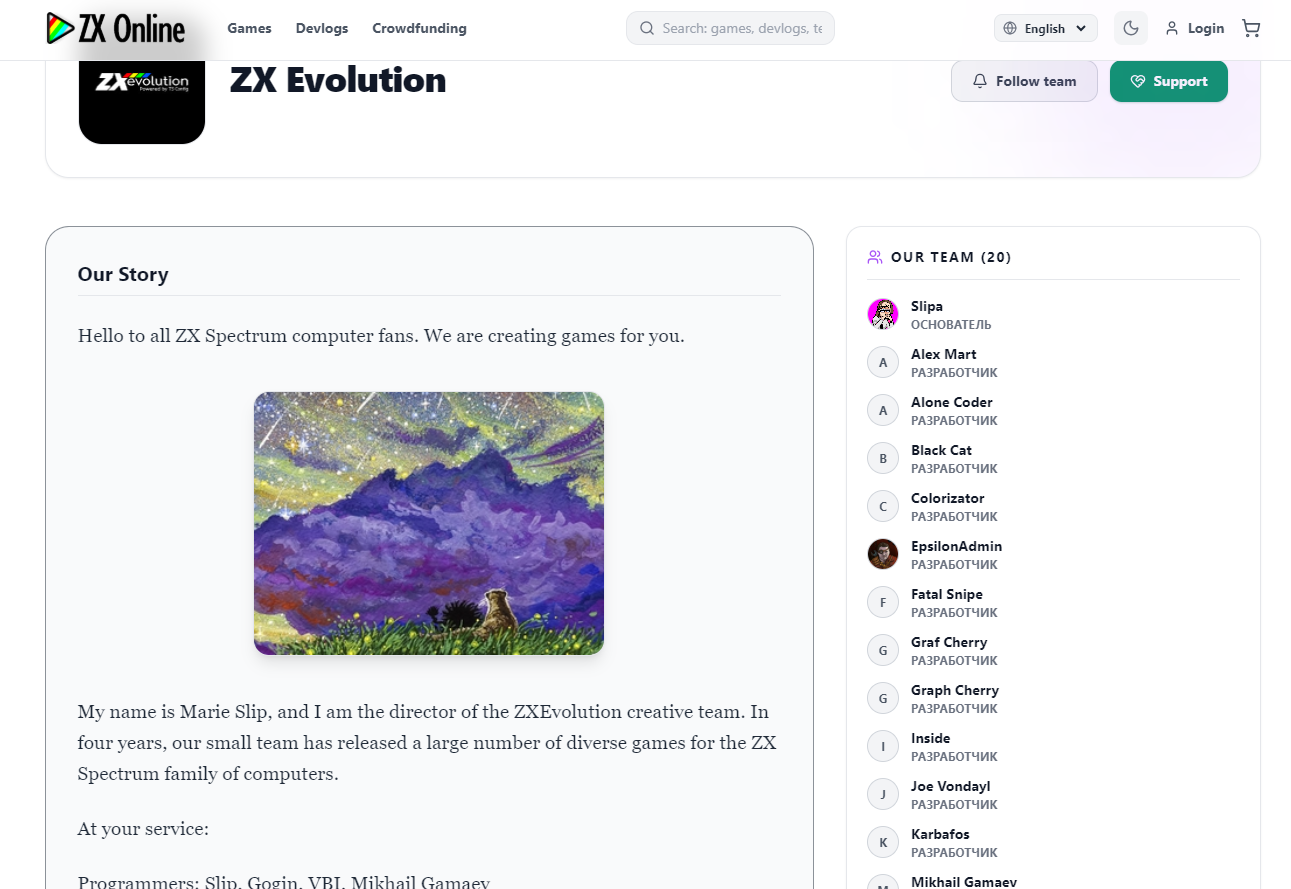
A team has a public page: name, description, members, roles. An indie team rarely has a large structure — usually it's a programmer, an artist, a musician, a writer, a narrative designer. Sometimes one person combines several roles. That's normal.
The page shows projects and their stages: concept, development, alpha, beta, release. Devlogs, media, goals and fundraising are visible. A player can understand who they're dealing with and what to expect.
The public page has a working side — ZX Online Forge, or "ZX Online's Forge." There the team manages projects, roles, devlogs and media. The player sees the result, the team works in one place.
The path
What matters isn't an individual page, but the connection between them:
team → project → devlog → wishlist → purchase.
The team talks about the project. The project accumulates devlogs. The player adds the game to their wishlist or subscribes to the team. When an update or release comes out, they find out. Then they can buy the game, leave a review and follow the next project.
This isn't a set of screens, but a story. And it doesn't start with a "buy" button, but with the first story about what the team is making.
Why this matters to players and teams
Players care who they're paying. When the team is visible, it's easier to understand what to expect and easier to support the authors. A wishlist and a subscription aren't marketing, but a way not to lose the game and the people making it.
A team doesn't need to wait for release to become known. A devlog helps show the process and build an audience in advance. The team page works as a public face. Fundraising and goals explain what the money is for, without unnecessary magic; details about money are in a separate article.
The strongest game gains nothing from its author staying invisible. And a weak one won't become strong just because it was shown to everyone indiscriminately. What's needed is an honest connection: the team tells, the player chooses.
The asset that remains
In the old model, a purchase was the final point. The email went out, the game was bought, the wishlist was closed — and the person disappeared. In the new model, they stay: a subscription to a team isn't tied to a single game. The next project reaches the same people, and they come back because they're interested in the team's work, not just a specific file.
This is how a team gains an asset — not a list of one-time buyers, but a growing community of fans. It can't be bought with a single newsletter: it accumulates with every game, every devlog, every promise kept. It's for these people that it's worth working and honing the next products. Motivation appears to grow the team, build the audience, and get the flywheel of popularity spinning.
What's already there
In 2.0, the team became a full-fledged participant. A public page, roles, projects, devlogs, media, subscribers and a wishlist appeared. Everything is connected into a single path.
The very principle has changed: news isn't received by everyone, but by those who are interested in it. This is better for players, better for teams, and allows the platform to grow without endless newsletters.
What's next
This is just the beginning. There will be more tools for teams, better pages, more opportunities for the community. We'll listen to feedback. We don't promise "everything at once," but we promise not to disappear.
If you're making a game — register a team, add a project and start a devlog. An audience begins not with a release, but with the first story about what you're making.
And if you're a player — find a team worth following and add their game to your wishlist.
ZX Online is people. Join us.
CREATE A TEAM
Comments (0)
Leave a comment
Log in to join the discussion.
Log in